
Compare 3 Star vs 5 Star AC electricity consumption, monthly running cost, and long-term savings using an AC Bill Calculator before buying your first air conditioner.
Star Rating Decision Guide for First-Time Buyers — Stop Confusing Yourself and Read This
Table of Contents
Walking into a showroom full of ACs with 3, 4, or 5 stars plastered everywhere can feel overwhelming. Your head spins with questions: Is 5 star always better? Does the higher price actually pay back? Here’s what most salespeople won’t tell you — star ratings only make sense when you convert them into real electricity costs.
A 5 star label means higher efficiency, but the savings depend entirely on how many hours you run the AC and your local per-unit rate. Instead of making a blind choice, you can plug those exact numbers into an Ac electricity consumption calculator and see the monthly bill difference in seconds.
A reliable ac bill calculator takes your room’s tonnage, daily run time, and electricity tariff, then shows exactly what a 3 star model costs versus a 5 star. First-time buyers often overspend on a higher star rating they’ll never recover, or underspend and face shocking summer bills. A quick session with an ac consumption calculator removes that confusion and lets you walk into the shop knowing your break-even point already.
How the AC Electricity Consumption Calculator Simplifies the Star Rating Choice for You
Let’s understand the real math most people skip. A 1.5 ton 3 star AC might gulp about 1.2 units every hour, while a 5 star inverter in similar conditions could pull just 0.9 units. That tiny difference per hour balloons into hundreds of units over a Delhi summer. But doing this calculation manually with a pen and the electricity board’s slab rates is messy. That’s exactly where an ac electricity consumption calculator does the heavy lifting — you input tonnage, star rating, daily usage, and your tariff, and it instantly churns out a per‑month running cost.
What surprises many buyers is that a 5 star unit often breaks even only after 3‑4 years if your daily usage is below 6 hours. For a guest room that runs occasionally, a 3 star could actually be the smarter money move. An ac power consumption calculator helps you map that payback period clearly, side‑by‑side. Some air conditioner bill calculator tools even let you compare models with the same star rating but different ISEER values, which can swing your bill by 5‑7%. Stop driving yourself in circles — let the real numbers guide your pick.
Choosing Between 3 and 5 Star Using Real Data From the 2 Ton AC Bill Calculator
When cooling a large hall or a family room, a 2 ton AC becomes the default choice, and here the 3 star vs 5 star debate gets tens of thousands of rupees heavy. Take a real‑world example: a 2 ton 3 star split AC running 8 hours daily in a city with a flat Rs 8 per unit rate. It may consume roughly 1.6 kW per hour, adding up to around 384 units a month. A 5 star inverter 2 ton under the same conditions might settle near 1.25 kW, using about 300 units.
That’s an 84‑unit gap translating to over Rs 670 every month, and nearly Rs 8,000 yearly. But here’s the twist — the upfront price difference between the two can be Rs 15,000 or more. You need a crystal‑clear payback calculation before swiping your card.
A dedicated 3 star vs 5 star ac power consumption calculator does exactly that. Feed your exact daily hours and per‑unit rate into a 2 ton ac bill calculator and you get a tailored ac bill estimate, not some glossy brochure promise. Many users in cities with lower tariffs find the 5 star payback stretches past 5 years. That insight changes the purchase decision entirely — try it with your local rate and see the reality.
Make Your Final Star Rating Decision After Running the 1.5 Ton AC Bill Calculator Today
Once you’ve seen the 2 ton numbers, it’s time to tackle the sweet spot of Indian homes — the 1.5 ton AC. Bedrooms, medium‑sized living rooms, and even home offices rely on this size, making the star rating decision a direct hit on your annual electricity budget. Don’t borrow someone else’s conclusion from a forum; your usage pattern is unique. Using the same ac bill calculator you trusted for the 2 ton, simply switch the capacity to 1.5 and run both 3 star and 5 star scenarios side‑by‑side. Many households run the AC only during night, say 7 hours, and wonder if the inverter premium is worth it.
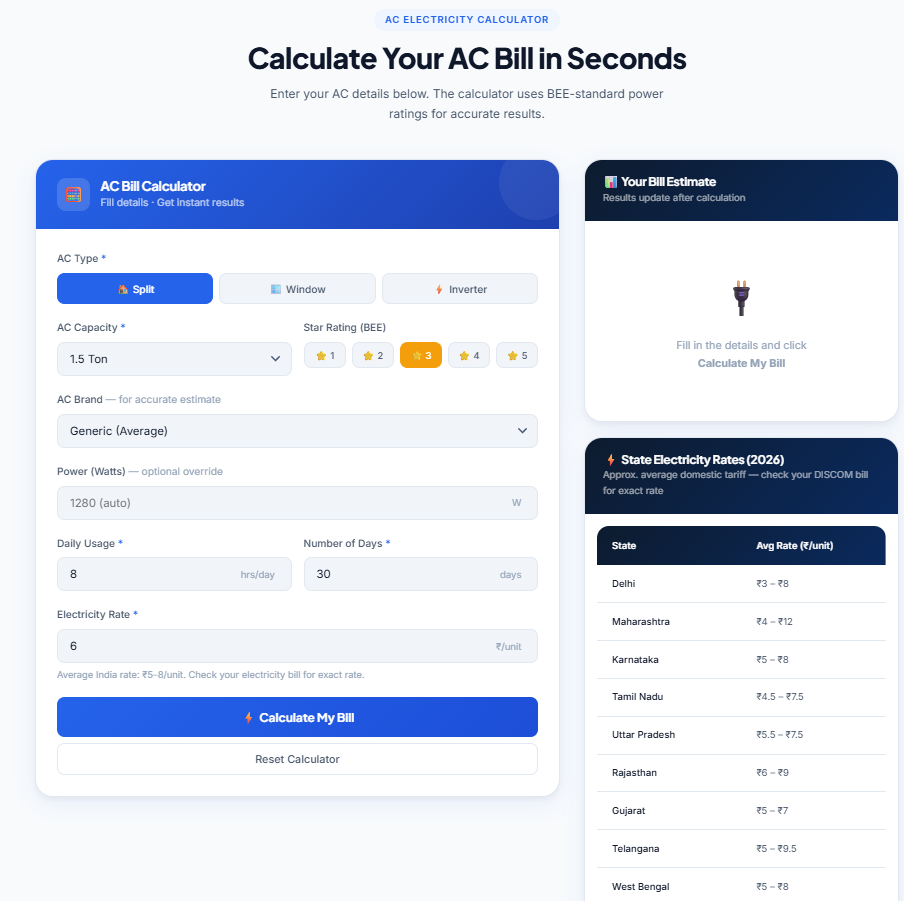
An ac monthly bill calculator will show your peak summer expense for each star rating right down to the rupee. And if you’re evaluating an inverter model, you can even calculate ac electricity bill numbers factoring in partial load efficiency curves — something that generic advice can’t provide. By now you have all the data: 1.5 ton vs 2 ton, 3 star vs 5 star, summer bills projected. The only missing piece is you running those numbers with your own electricity rate. Do that right now and lock in the star rating that truly makes sense.
1.5 Ton AC Bill Calculator 2 Ton AC Bill Calculator 3 Star vs 5 Star AC Guide 3 star vs 5 star ac power consumption calculator Ac bill calculator Ac consumption calculator Benefit of window ac calculate Ac bill cooling ac portable ac Portable AC vs Window AC pros of portable ac window ac
About the Author



Hi, this is a comment.
To get started with moderating, editing, and deleting comments, please visit the Comments screen in the dashboard.
Commenter avatars come from Gravatar.